A Problem of Pálfy and Saxl
Suppose the lattice shown below is a congruence lattice of an algebra.
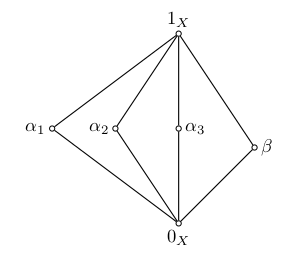
Conjecture: If the three \(\alpha_i\)'s pairwise permute, then all pairs in the lattice permute.
An older post
This post is from an earlier period of work and has not been revised since it was written. It is here because it still stands, not because it is current: names, links and affiliations are as they were at the time.
Whether or not this claim is true is a simplified version of a question left open by Pálfy and Saxl at the end of their 1990 paper. Below is a more formal statement of the problem, and a link to my notes describing a proposed method of solution. There remains one gap in the proof, that I'm not yet sure how to fill, but I am hopeful that the overall strategy will work.
Graphical composition
In an attempt to prove the claim above and its generalization, I apply an idea described in Heinrich Werner's paper called graphical composition.
The Problem
Before giving a more precise statement of the problem, let us recall a couple of basic definitions. Given two equivalence relations \(\alpha\) and \(\beta\) on a set \(X\), the relation
is called the composition of \(\alpha\) and \(\beta\), and if \(\alpha \circ \beta = \beta \circ \alpha\) then \(\alpha\) and \(\beta\) are said to permute.
Problem. Let \(\bA\) be a finite algebra with \(\operatorname{Con} \bA\) isomorphic to \(M_n\), for some \(n\geq 4\). If three nontrivial congruences of \(\bA\) pairwise permute, does it follow that every pair of congruences of \(\bA\) permute?
GitHub repository
My GitHub repository contains the following: